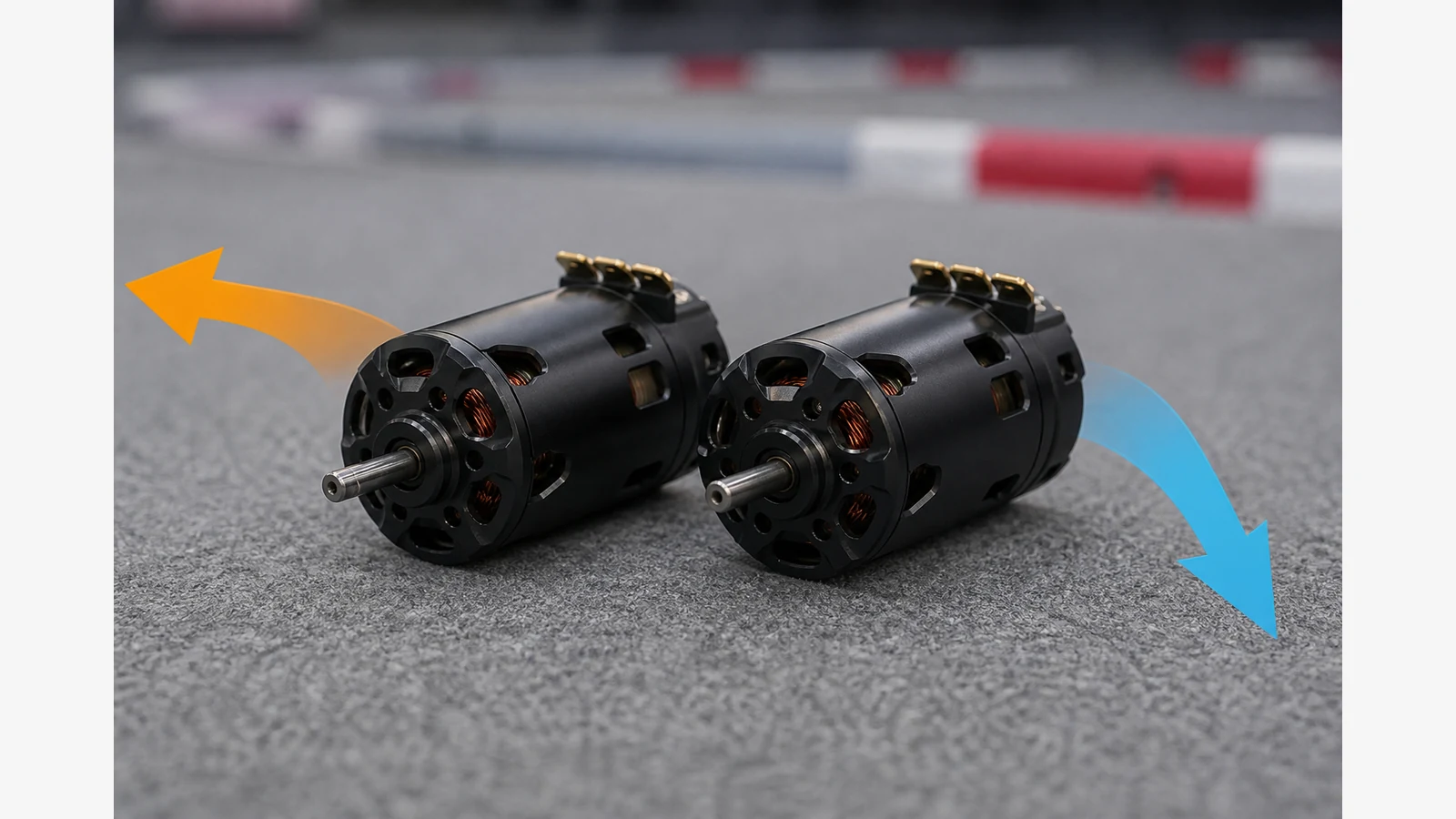
10.5T vs 13.5T RC drift motor UK: pick turns by track and skill
For most UK 1/10 drift club nights, 13.5T is the forgiving default and 10.5T is the step up when you already modulate throttle well and want more wheel-speed headroom on larger or grippier layouts. Pick turns by track size and skill, not by ego.
Lower turn counts usually mean higher RPM potential and a hotter, less forgiving powerband. UK pairing notes often place experienced carpet drivers around 10.5T, with 13.5T–17.5T covering newer drivers and tighter or lower-grip surfaces — summarised in the RC Drift UK motor and ESC pairing article.
How turn count changes the car
Buyer guides commonly start most 1/10 drift builds on 10.5T or 13.5T, preferring 13.5T while you are still learning throttle modulation or running tight layouts. See the RC Pit Lane guide to choosing an RC drift motor. Lower T can feel sharper on exit, but it also asks more from gearing, pack C-rating, cooling, and driver skill.
UK retail listings for drift-specific 10.5T 540 sensored motors are common and often talk in 2S–3S pairing language — for example this UK retailer 10.5T drift motor listing. Treat those as market context, not as a dyno comparison against any one brand.
UK decision path
| Situation | Usually start here | Why |
|---|---|---|
| New RWD driver, tight indoor carpet | 13.5T | More forgiving mid-range and heat margin |
| Experienced carpet driver, larger grip | 10.5T | Extra wheel-speed headroom once modulation is sorted |
| Outdoor concrete, lower grip | 13.5T (or higher) | Avoid overpowering a slippery surface |
| AWD with strong ESC boost available | Either, with caution | Boost can make a higher-T motor feel stronger — change one variable at a time |
Who should not jump to 10.5T yet
If you are still learning RWD throttle and gyro coordination, a hotter 10.5T mainly amplifies mistakes and heat. Fix gearing, tyre compound, and ESC drift mode first. Timing advance is a separate lever — cover that in the brushless motor timing guide for UK RC drift.
Checklist before you swap cans
- Confirm pinion/spur so the motor is not over-geared for the new T count.
- Use a pack with enough C-rating for punchy club runs.
- Plan airflow or a short cool-down between packs.
- If your ESC has boost/turbo, start conservative so you can feel the motor itself.
- Compare sensored vs sensorless only after turn count is settled — see sensored vs sensorless for UK RC drift.